hrinfomaths@gmail.com | +91 98721-24534 | +91 98786 24534

Connect with Infomaths.

Follow Us

Popular searches

Notifications

Admission

Admissions are open now

Nov 12, 2025

MCA Entrance Test Series

Comprehensive test series for all MCA entrance exams.

Start Test Nov 12, 2025

IIT JAM Mathematics

Advanced mathematics preparation for IIT JAM exam.

Learn More Nov 12, 2025

NIMCET Special Coaching

Special coaching sessions for NIMCET aspirants starting next week.

Register Now Nov 12, 2025

Welcome to Info Maths 2025

Start your journey with our comprehensive MCA entrance preparation program. Join thousands of successful students.

Explore Courses Nov 12, 2025
Home CSIR NET / JRF

Best Coaching for CSIR NET / JRF

Join the league of toppers with India's most trusted coaching institute for CSIR NET. Expert Faculty, Proven Results, 24/7 Supports.

Expert Faculty
Proven Results
24/7 Support

Book Free Consultation

Get expert guidance for your career path

CSIR NET Main Content

Introduction

This exam named as CSIR NET is conducted by CSIR (Council of Scientific and Industrial Research) with the objective to determine the eligibility of the candidates of India, which is awarded with Junior Research Fellowships (JRF) /NET (National Eligibility Test) and also to determine eligibility for the appointment of Lecturers (NET) in a number of subjects that fall under the stream of Science & Technology. Exams conducted by CSIR are in the following areas:-

  • Chemical Sciences
  • Earth Sciences
  • Atmospheric Sciences
  • Ocean Sciences
  • Planetary Sciences
  • Life Sciences
  • Mathematical Sciences
  • Physical Sciences

Overview

Introduction

This exam named as CSIR NET is conducted by CSIR (Council of Scientific and Industrial Research) with the objective to determine the eligibility of the candidates of India, which is awarded with Junior Research Fellowships (JRF) /NET (National Eligibility Test) and also to determine eligibility for the appointment of Lecturers (NET) in a number of subjects that fall under the stream of Science & Technology. Exams conducted by CSIR are in the following areas:-

 Chemical Sciences

 Earth Sciences

 Atmospheric Sciences

 Ocean Sciences

 Planetary Sciences

 Life Sciences

 Mathematical Sciences

 Physical Sciences

Educational Qualification

M.sc or equivalent degree/B.E./B.Tech/MBBS/B.Pharma/BS-4years/Integrated BS-MS with 55% marks for general and OBC-Non Creamy layer candidates and 50% of SC/ST, Persons with disability (PwD) candidates.

Candidates who enrolled for M.Sc or having completed 10+2+3 years of the above qualifying examination, candidates whose result are awaited (RA) are also eligible to apply to the condition that they complete their degree with the requisite percentage of marks within the validity period of two years to avail the fellowship from the effective date of the award.

These types of candidates will have to submit the attestation format (Given on reverse of the application form) duly certified by the Head of the Department/Institute from where the candidate appears or has appeared.

B. SC (Hons) or equivalent degree holders or students enrolled in Integrated MS-PhD program with at least 55 % marks for general and OBC (Non Creamy Layer) candidates; 50% marks for Sc/ST, persons with disability (PwD) are also eligible. The candidates who acquired only a bachelor’s degree will be eligible for the fellowship only after getting enrolled/registered for PhD/ Integrated PhD program within the validity period i.e. 2 years.

The eligibility for lectureship of NET qualified candidates depends on the subject to fulfilling the criteria laid down by UGC. PhD degree holders who have passed Master Degree with minimum 50% marks eligible to apply for Lectureship only.

Examination Centers

The exam will be conducted in more than 27 cities which are spread all over the India. Name of the centres is defined below

BhopalBangaloreBhavnagarBhubaneshwarChennaiChandigarhCochinGunturDelhi
HyderabadGuwahatiImphalJamshedpurJammuJorhatKolkataNagpurLucknow
KaraikudiPilaniRaipurSrinagarUdaipurPuneRoorkeeThiruvananthapuramVaranasi

Any candidate may opt any of the above describe centers. No request for the change of the center would be granted, however, request in writing may entertain on the merits. If at any center the numbers of appearing candidates are not sufficient, then that particular center may be deleted or any other nearest center will be allotted to the candidate at the discretion of CSIR. No TA/ DA will be allotted to any candidate for attending the exam in any manner.

Age Limit
Exam NameAge Limit
JRF (NET)Maximum 28 years at the time of appearing in the exam (This limit may be relaxed up to 5 years in case of SC/ST/OBC(non Creamy Layer)/ Persons with Disability and female applicants)
LS (NET)No Upper Age Limit
Examination Structure

There are three parts in the CSIR Question Paper named as (A, B & C) as per syllabus & Scheme of Exam

Part A: This is common to all subjects. This part contains questions related to General Aptitude with emphasis on logical reasoning, graphical analysis, numerical ability, quantitative comparison, puzzles, series formation and analytics etc.

Part B: This part contains Multiple Choice Questions (MCQs) covering all the topics in the syllabus

Part C: This is the trickiest part of paper which contains the High Value Question which is designed to test the knowledge on Scientific Concept of the candidates. The questions are analytical in nature where it is necessary for the candidate to apply their scientific logic to reach the solution of the given Scientific Problem.

Note: The revised exam scheme and model Question paper may be seen at CSIR HRDG website https://csirnet.nta.nic.in/

MARKING SCHEME
Negative marking for wrong answers, wherever required, shall be applicable as per subject wise scheme of the exam. If in any case, question found to be wrong, benefit of marks will be given to only those candidates who attempt the question. No representation of Answer key after declaration of result will be entertained.

Syllabus

CSIR  NET Syllabus -Part A

Part A consists of questions related to General Science, Quantitative Reasoning, and Analysis and Research Aptitude. It contains 20 multiple-choice questions (MCQs), and candidates are required to answer any 15 of them. Each question carries two marks.

SectionTopics
Reasoning
  • Analytical Reasoning
  • Syllogisms
  • Analogies
  • Directions
  • Coding-Decoding
  • Classification
  • Alphabet Series
  • Symbols and Notations
  • Similarities and Differences
  • Number Series
  • Blood Relationships
  • Arrangements
  • Statements
  • Data Sufficiency
  • Non-verbal Reasoning
  • Visual Ability
  • Graphical Analysis
  • Data Analysis
Quantitative Aptitude
  • Simplifications
  • Number System
  • Average
  • Algebra
  • Percentage Time & Work
  • Simple & Compound Interest
  • Time & Speed
  • HCF, LCM Problems
  • Area
  • Profit & Loss
  • Bar Graph, Pictorial Graph, Pie Chart
  • Ratio & Proportion
  • Permutation & Combination
Data Interpretation & Graphical Analysis
  • Mean
  • Median
  • Mode
  • Measures of Dispersion
  • Graphical Analysis: Bar Graph, Line Graph, Pie-Chart and Tabulation

CSIR  NET Syllabus - Part B & C

Candidates can find the subject-wise CSIR NET Syllabus 2025 in this article. The CSIR NET Syllabus for Parts B and C is important for candidates, as this section plays an important role in the CSIR NET Exam.

Life Science 

  • Molecules and their Interaction Relevant to Biology
  • Cellular Organization
  • Fundamental Processes
  • Cell Communication and Cell Signaling
  • Developmental Biology
  • System Physiology – Plant
  • System Physiology – Animal
  • Inheritance Biology
  • Diversity of Life Forms
  • Ecological Principles
  • Evolution and Behavior
  • Applied Biology
  • Methods in Biology

Physical Science 

  • Mathematical Methods of Physics
  • Classical Mechanics
  • Electromagnetic Theory
  • Quantum Mechanics
  • Thermodynamic and Statistical Physics
  • Electronics and Experimental Methods

Mathematical Science

  • Analysis
  • Linear Algebra
  • Complex Analysis
  • Algebra
  • Ordinary Differential Equations (ODEs)
  • Partial Differential Equations (PDEs)
  • Numerical Analysis
  • Calculus of Variations
  • Linear Integral Equations
  • Classical Mechanics
  • Descriptive Statistics, Exploratory Data Analysis

Earth Science

  • The Earth and the Solar System
  • Earth Materials, Surface Features and Processes
  • Interior of the Earth, Deformation and Tectonics
  • Oceans and Atmosphere
  • Environmental Earth Sciences

Exam Pattern

The Council of Scientific and Industrial Research (CSIR) conducts the National Eligibility Test (NET) every year for various subjects, including Chemical Sciences, Earth Sciences, Life Sciences, Mathematical Sciences, and Physical Sciences. CSIR NET determines the eligibility for the Junior Research Fellowship (JRF) and Lectureship position. To prepare well, it is important for the candidates to have a clear idea of the syllabus and CSIR NET Exam Pattern 2025. Read the article to know the exam pattern for all five subjects.

CSIR NET Exam Pattern

Candidates appearing for the CSIR Exam must understand the CSIR NET Exam Pattern and will consist of multiple-choice questions carrying a total of 200 marks, divided into three sections: Part A, Part B, and Part C. Part A is common to all subjects and tests the general aptitude of the candidates. Part B and C are subject disciplines, and the number of questions differs as per the selected subjects. In this article, the complete exam pattern for every subject has been given in a well-structured format.

CSIR NET Exam Pattern Subject-Wise

Before starting preparation for the National Eligibility Test (NET), candidates must be familiar with the CSIR NET Exam Pattern. The exam pattern for NET depends on the subject chosen by the candidates. Each subject has its own exam format, with varying numbers of questions. CSIR exam is conducted for 5 subjects:

  1. Chemical science,
  2. Earth science,
  3. Life science,
  4. Mathematical Science
  5. Physical Science.

CSIR NET Exam Pattern for Chemical Science

Students who want to start a career in chemistry as a Professor or Junior Research Fellowship (JRF) must check the exam pattern for Chemical science. Candidates have to prepare each for all parts. The major subjects covered in the exam are organic chemistry, inorganic chemistry, physical chemistry, etc. This exam needs a detailed understanding of the subject to score good marks. The exam pattern for Chemical science is as follows.

  • A total of 120 questions will be asked
  • Part A and B- Each question carries 2 marks.
  • Part C- Each question carries 4 marks
  • ¼ marks will be deducted for each incorrect attempt
  • 3 hours will be given to complete the paper

CSIR NET Exam Pattern for Earth Science

Candidates who are preparing for the CSIR Earth Science must focus on important topics like, Sedimentology, Geochemistry, The Earth and the solar system, Earth’s interior, tectonic plates, deformation, Oceans and atmosphere, etc. Also, the understanding of exam patterns is important and it is explained below.

  • A total of 150 questions will be asked
  • Part A and B- Each question carries 2 marks.
  • Part C- Each question carries 4 marks
  • 25% marks will be deducted for each incorrect attempt and 33% deducted in Part C.
  • 3 hours will be given to complete the paper

CSIR NET Exam Pattern for Life Science

The CSIR NET Life Science exam pattern and marking scheme helps candidates to prepare the study plan for the exam. Topics in the Life Sciences syllabus include Photosynthesis, Molecules and their Interaction Relevant to Biology,  Developmental Biology, System Physiology Plant, System Physiology Animal, Inheritance Biology, Diversity of Life Forms, Cellular Organization, Fundamental Processes, Cell Communication and Cell Signaling etc. The table below provides more details on the exam pattern for better clarity.

  • A total of 145 questions will be asked
  • Part A and B- Each question carries 2 marks.
  • Part C- Each question carries 4 marks
  • 25% marks will be deducted in all parts for each incorrect attempt
  • 3 hours will be given to complete the paper

CSIR NET Exam Pattern for Mathematical Science

Candidates who opted the Mathematical science must know the exam pattern and syllabus for the CSIR NET exam which consists of the following topics Analysis, Linear Algebra, Complex Analysis, Calculus of Variations, Linear Integral Equations, Classical Mechanics, Algebra, Numerical Analysis, Topology, Ordinary Differential Equations (ODEs), etc.

  • A total of 120 questions will be asked
  • Part A gives 2 marks for each question, Part B gives 3 marks for each question, and Part C gives 4.75 marks for each question.
  • 25% marks will be deducted in Part A and B and no negative marking in Part C.
  • 3 hours will be given to complete the paper

CISR NET Exam Pattern for Physical Science

The exam pattern and marking scheme of the CSIR Physical Sciences paper help candidates to know the overview of the exam structure. This subject includes the core topics like Classical Mechanics, Electromagnetic Theory, Quantum Theory, Condensed Matter Physics, Nuclear and Particle Physics, and Atomic and Molecular Physics etc. To know important points on the exam pattern, the table below is provided.

  • A total of 75 questions will be asked
  • Part A gives 2 marks for each question, Part B gives 3.5 marks for each question, and Part C gives 5 marks for each question.
  • 25% marks will be deducted in Part A, B and C
  • 3 hours will be given to complete the paper

Eligibility Criteria

CSIR NET  Eligibility Criteria

Candidates must fulfill the following criteria to apply for CSIR NET  Session. Candidates applying for JRF must be 30 years or younger, while there is no age limit for those applying for Assistant Professor or Ph.D. admission through CSIR December NET.

ParametersEligibility
Nationality Indian citizen
Upper Age Limit  (As of 1/10/2025)JRF- 30 years 
Assistant Professor & Ph.D. Admission- No age limit
Education Qualification
  • General/Unreserved/EWS Candidates must have at least 55% marks (no rounding off) in their Master’s degree or equivalent from a recognized university.
  • OBC (Non-Creamy Layer)/SC/ST/PwD/Third Gender Candidates must have at least 50% marks.
  • Students who are in the final year of their Master's degree, or awaiting results, can also apply.
  • Four-Year Bachelor’s Degree Holders must have at least 75% marks or equivalent grade.

CSIR NET  Application Fee

The applicants have to pay the CSIR NET application fee in online mode via debit card/credit card/internet banking. The category-wise application fee is as follows.

CategoryCSIR NET Application Fee
GeneralRs. 1150/-
EWS/ OBC – Non-creamy layerRs. 600/-
SC/ST/PwD/Third GenderRs. 325/-
PwDNIL

Steps to Apply for CSIR NET

Candidates can apply for the CSIR Eligibility test for the session by following these simple steps.

PART I: Registration

  1. Register on the official website to get your Application Number.
  2. Enter basic details as per your Class 10 certificate:
  3. Full Name (No prefixes like Mr./Ms..), Mother’s and Father’s Name, Date of Birth (Format: dd/mm/yyyy), Use your own mobile number and email ID (only one per application).
  4. Email and phone number can’t be changed later, so be careful.

PART II: Fill the Complete Application Form

  1. You can edit your form before final submission.
  2. The form can be filled in multiple steps, you can save it as a draft and complete it later before the last date.
  3. Upload documents, pay the fee, and print the Confirmation Page.
  4. Form is considered submitted only after fee payment is successful.
  5. OBC (Non-Creamy Layer) should refer to the central list on www.ncbc.nic.in
  6. Enter gender, address with PIN Code, subject of the exam, and preferred exam cities carefully these cannot be changed later.

PART III: Upload Documents

Make sure all files are clear, scanned, and in correct specifications

Photograph

  1. Clear face, no cap/goggles, white background, 80% face visible.
  2. JPG/JPEG format only, 10 kb to 200 kb.
  3. Spectacles allowed if worn regularly.
  4. No computer-generated or altered photos.

Signature

  1. Full signature in running handwriting.
  2. Use blue/black pen on white paper.
  3. JPG/JPEG format, 10 kb to 50 kb.

PART IV: Pay Exam Fee

  1. Pay via Net Banking / Credit Card / Debit Card / UPI.
  2. Save a copy of the payment receipt for future reference.

University Board

Infomaths Notice

Our Gallery 📰

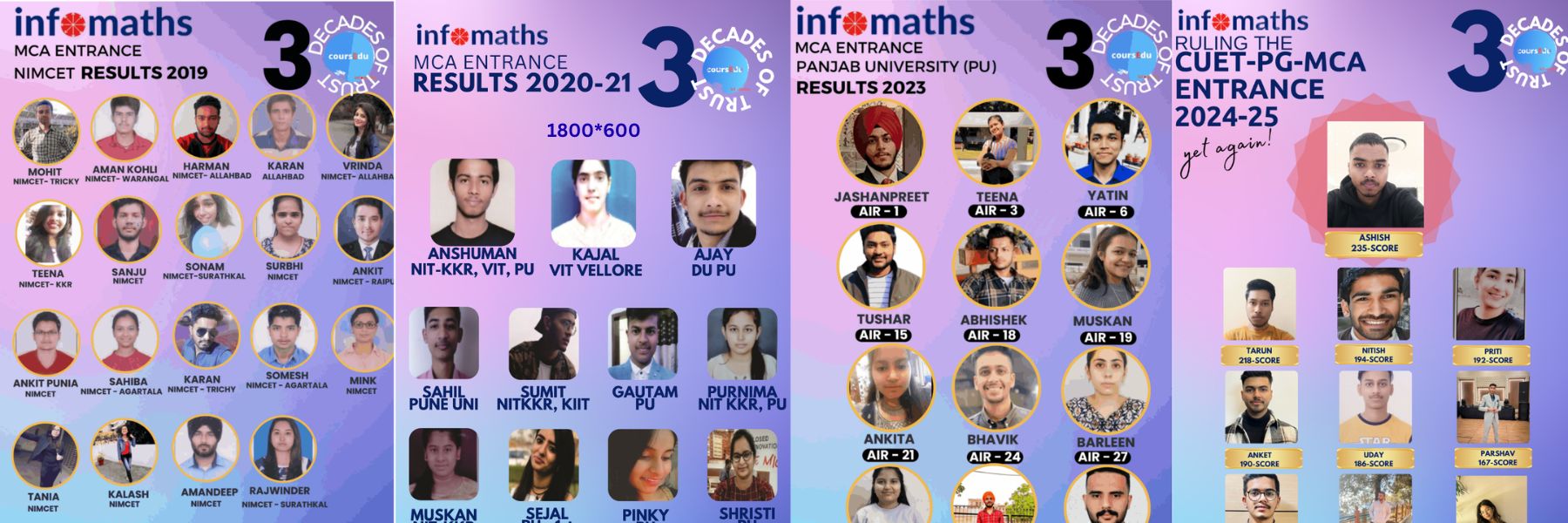
Top Results by Our Stars

Selected Candidates

Topper 1
Topper 2
Topper 3
Topper 4
Topper 5
Topper 6

Our Testimonials

What Our Students Say About Us

Hear from our students about their journey and success at Infomaths.

ANANYA

ANANYA

MAHCET - 100%IL NIT-WARANGAL, VIT-56

RAHUL GUPTA (MCA 2018-19 BATCH)

RAHUL GUPTA (MCA 2018-19 BATCH)

NIT SURATHKAL,IP,HCU,DU,VIT,JNU

PAYAL JAIN (MCA 2016-17 BATCH)

PAYAL JAIN (MCA 2016-17 BATCH)

PUNE UNIV,IP,IIT BHU-3RD

NEERAJ TAYAL(MCA 2018-19 BATCH)

NEERAJ TAYAL(MCA 2018-19 BATCH)

MAHCET-7 TH , IP, KIIT, VIT, NIT ALLAHABAD

The Team Behind Your Success

Meet Our Expert Members

Mr. Sudhir Grover

Mr. Sudhir Grover

Sr. Faculty [Maths], 21+ Yr. Experience.

Ms. Arpana

Ms. Arpana

Sr. Faculty [English], 19+ Yr. Experience.

Mr. Sanjay Gupta

Mr. Sanjay Gupta

Sr. Faculty [Comp.], 18+ Yr. Experience.

Ms. Palak Soni

Ms. Palak Soni

FACULTY (GK) .10 YR EXP

Mr. Ram Kumar

Mr. Ram Kumar

Faculty [Aptitude], 6+ Yr. Experience.

Mr. Saurabh

Mr. Saurabh

Faculty [Aptitute], 5+ Yr. Experience.

MR. RAVINDER JOSHI

MR. RAVINDER JOSHI

FACULTY (APTITUTE) .11 YR EXP

Mr. ARUN Sir

Mr. ARUN Sir

AVAILABLE ON GOOGLE PLAY & APP STORE

Download our App

Experience the future of entrance exam preparation with our comprehensive mobile app. Access study materials, practice tests, and expert guidance anytime, anywhere.

Check Our Demo Lectures

Sample Video Lectures

WhatsApp